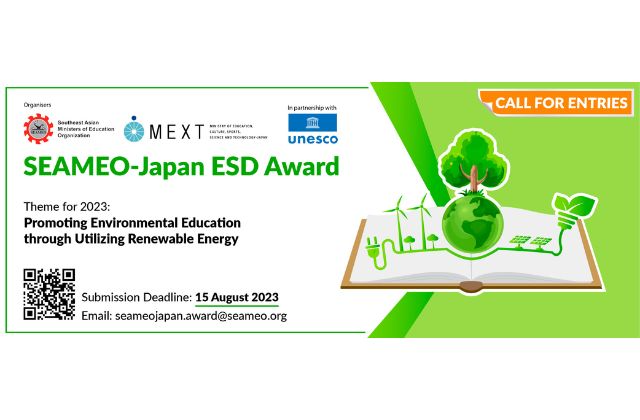
SEAMEO JAPAN-ESD AWARD
Call for Entries
"Promoting Environmental Education through Utilizing Renewable Energy"
In 2002, the United Nations General Assembly adopted Resolution 57/254 and declared the period 2005-2014 as the “United Nations Decade of Education for Sustainable Development” (DESD).
The UNESCO General Conference at its 40th Session and the UN General Assembly at its 74th Session in 2019 endorsed Education for Sustainable Development: Towards achieving the SDGs (ESD for 2030) as the global framework for implementation of ESD from 2020-2030.
ESD for 2030 builds upon the lessons learned from the Global Action Programme on ESD (GAP, 2015-2019), in response to the increased importance placed on ESD to promote the contribution of learning content to the survival and prosperity of humanity. ESD 2030 places emphasis on education’s contribution to the achievement of the SDGs. It aims to review the purposes and values that underpin education and reorient all levels of education and learning to contribute to sustainable development and to strengthen education and learning in all activities that promote sustainable development.
While ESD is implemented worldwide under the GAP, in support of further promoting ESD in Southeast Asia, the Southeast Asian Ministers of Education Organization (SEAMEO) and the Ministry of Education, Culture, Sports, Science and Technology, Japan (MEXT), in cooperation with the UNESCO Multisectoral Regional Office in Bangkok, have shown their collective commitment to promote best practices in ESD in schools across Southeast Asia, by organizing the SEAMEO-Japan Education for Sustainable Development (ESD) Award. The award scheme has been held annually since 2012.
The objectives of the SEAMEO-Japan ESD Award are:
- To raise awareness of ESD in schools and communities across Southeast Asia;
- To promote ESD best practices in schools and communities across Southeast Asia;
- To share and exchange knowledge and best practices on ESD in schools across Southeast Asia and Japan;
- To encourage networking among schools and communities which implement ESD practices in Southeast Asian countries and Japan; and
- To support the Sustainable Development Goals (SDGs) of United Nations.
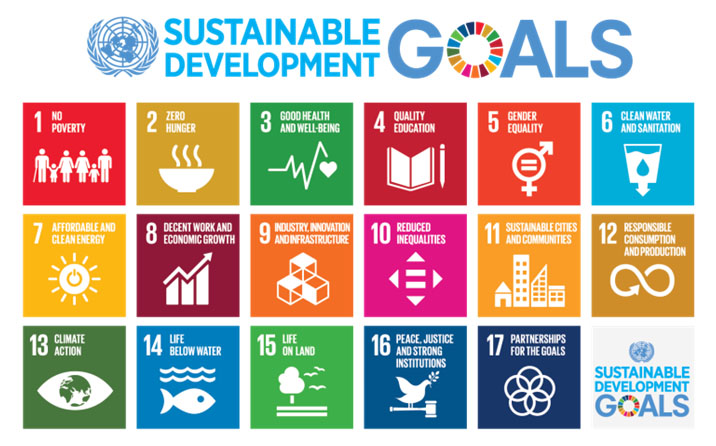
* The Sustainable Development Goals (SDGs) consist of 17 integrated and interdependent global goals with associated 169 targets, which aim to shift the world on to a path towards sustainable and resilient development.
https://sustainabledevelopment.un.org/sdgs
Since 2012, the Award has been conducted with the following themes and participated by the following number of schools in Southeast Asia.
| Year | Theme | Number of Participated Schools | Participated Countries in Southeast Asia |
| 2012 | Education for Disaster Risk Reduction | 69 | 7 Countries: Indonesia, Lao PDR, Malaysia, Myanmar, Philippines, Thailand, and Vietnam |
| 2013 |
Values Education | 126 | 8 Countries: Brunei Darussalam, Indonesia, Lao PDR, Malaysia, Myanmar, Philippines, Thailand, and Vietnam |
| 2014 | Fostering Global Citizenship for Sustainable Future | 63 | 9 Countries: Brunei Darussalam, Indonesia, Lao PDR, Malaysia, Myanmar, Philippines, Singapore, Thailand and Vietnam |
| 2015 | Safeguarding our Cultural Traditions | 90 | 10 Countries: Brunei Darussalam, Cambodia, Indonesia, Lao PDR, Malaysia, Myanmar, Philippines, Singapore, Thailand, and Vietnam |
| 2016 | Saving Energy | 43 | 8 Countries: Brunei Darussalam, Indonesia, Lao PDR, Malaysia, Myanmar, Philippines, Singapore, and Thailand |
2017 |
Improving Health and Nutrition | 56 | 8 Countries: Brunei Darussalam, Indonesia, Malaysia, Myanmar, Philippines, Singapore, Thailand, and Vietnam |
| 2018 | Applying Local Wisdom for Environmental Conservation | 94 | 7 Countries: Brunei Darussalam, Indonesia, Cambodia, Malaysia, Myanmar, Philippines, and Thailand |
| 2019 | Building Peace in Schools and Communities | 79 | 9 Countries: Brunei Darussalam, Indonesia, Lao PDR, Malaysia, Myanmar, Philippines, Singapore, Thailand, and Vietnam |
| 2020 | Addressing Plastic Problems for Transforming Communities | 181 | 9 Countries: Brunei Darussalam, Cambodia, Indonesia, Lao PDR, Malaysia, Myanmar, Philippines, Thailand, and Vietnam |
| 2021 |
Securing Educational Opportunities in COVID-19 Crisis | 282 | 8 Countries: Brunei Darussalam, Cambodia, Indonesia, Malaysia, Philippines, Singapore, Thailand, and Vietnam |
| 2022 | Education Transformation through Partnership | 278 | 8 Countries: Brunei Darussalam, Cambodia, Indonesia, Lao PDR, Malaysia, Myanmar, Philippines, and Thailand |
The environment plays a vital role in the health of all species and the existence of life on Earth. We are all rely on the environment for resources like water, air, and food. Therefore, it becomes essential for everyone to protect and save the environment. Unfortunately, many people are not aware of environmental issues, lack information, and have less understanding about the importance of the environment which is the cause of its destruction. Thus, integrating environmental education into all learning programmes is a key to save our planet, our life, and shift to a sustainable future.
Environmental education is a process that allows individuals to explore environmental issues, engage in problem solving, and take actions to improve the environment. As a result, individuals develop a deeper understanding of environmental issues and have the skills to make informed and responsible decisions. The current climate emergency and other environmental sustainability crises nowadays are the product of human behaviour. The use of fossil fuels, i.e. coal, oil, and gas, is one of the primary causes of climate change causing severe environmental problems such as rising temperatures, sea-level rise, and more frequent and intense natural disasters. To avoid the worst impacts of climate change, emissions need to be reduced by ending our reliance on fossil fuels and investing in renewable energy sources that are clean, accessible, affordable, sustainable, and reliable. The examples of renewable energy sources are sun, wind, water, waste, and heat from the earth, which are replenished by nature and emit little to no greenhouse gases or pollutants into the air.
Considering the importance of environmental education and renewable energy utilization, the 2023 SEAMEO-Japan ESD Award selects the theme “Promoting Environmental Education through Utilizing Renewable Energy”. The objectives of this year’s award scheme are:
- to increase public awareness and acquire knowledge, skills, values, experiences, and also the determination to solve present and future environmental problems;
- to encourage schools and communities in Southeast Asia and Japan to use renewable energy to reduce the impact of climate change and create a more sustainable and environmentally friendly future;
- to promote and share initiatives and good practices that integrate environmental education and the use of renewable energy into teaching and learning practices and school’s programmes.
Under the theme of “Promoting Environmental Education through Utilizing Renewable Energy”, the school entry should cover the following areas:
- The entry should be relevant to the theme and the scope of “Promoting Environmental Education through Utilizing Renewable Energy” as defined above.
- The entry should highlight the school’s programme that promotes to use renewable energy such as environmental education regarding efficient use of the locally produced energy sources including biomass and environmental education through utilizing the school facilities. The entry should also describe how the school’s programme can contribute to a more sustainable society and environment.
- The school’s programme should be mainly led by students in cooperation amongst teachers, other students, parents and communities.
- The entry should clearly demonstrate the integration of “Environmental Education through Utilizing Renewable Energy” in the entire school’s policy, management plan, participatory planning and implementation, curriculum, teaching and learning practices, partnership efforts, parent and community participation, and so on.
All public and private kindergarten / elementary / secondary / vocational and technical (up to Grade 12) schools in 11 Southeast Asian countries – namely Brunei Darussalam, Cambodia, Indonesia, Lao PDR, Malaysia, Myanmar, Philippines, Singapore, Thailand, Timor-Leste and Vietnam – are invited to submit information about initiatives that are related to the theme of this year’s competition.
1) 1st Prize Winner
- USD$1,500
- A study tour to Japan for students and teachers who are involved in planning and implementing the school’s activities. (The organizer will sponsor the travel expenses for four to six persons, which includes round-trip airfares, accommodation for three nights, domestic transportation in Japan, interpreter, and visa fees).
2) 2nd Prize Winner
- USD$1,000
3) 3rd Prize Winner
- USD$500
4) A Special Prize from the SEAMEO Secretariat for the best programme carried out in small schools of less than 250 students
- USD$1,000
All winning schools will receive a Plaque of Recognition and Certificate of Appreciation for teachers and students involved in planning and implementing the school’s initiative.
A representative from the winning schools will be sponsored to participate at the award presentation ceremony which will be held at the SEAMEO High Officials Meeting in November 2023, Bangkok, Thailand.
All shortlisted schools will receive Certificate of Recognition for the school. The coordinators of shortlisted schools (Maximum of 2 persons) will receive the Certificate of Appreciation.
All participating schools that have submitted entries relevant to the theme will be recognized (name, project name and country) on the SEAMEO website and receive the Certificate of Participation.
The judging committee will consider the following criteria in selecting the winning schools:
1. Strategy/Modality of Implementation
- The school has demonstrated clear school’s plans and policies, effective strategies, and programme components/activities on how to implement the school’s programme.
- Appropriate and effective methods and resources are used to implement the programme.
- Monitoring and evaluation mechanisms or processes are identified to ensure the immediate and long-term outcomes.
- The school has demonstrated the use of participatory processes – involving students, teachers, parents, community stakeholders and partners – in planning and implementing the programme.
2. Teaching and Learning Approaches
- The school has integrated environmental education and utilizing renewable energy into teaching and learning practices and school’s programmes to ensure that students are able to connect the practices into their daily life, the local environment and community.
3. Innovation and Creativity
- The school’s programme has demonstrated innovative practice in relation to the theme that can be replicated.
- The school has demonstrated innovative ideas for utilizing available resources.
4. Engagement with Community
- The school has engaged community partners such as neighbouring educational institutions, local government authorities and parent associations to co-implement the school’s programme.
- The school’s programme has increase public awareness and action to use renewable energy to reduce the impact of climate change and create a more sustainable and environmentally friendly future.
- The school’s programme has strengthened student involvement and contribution to improve the sustainably environmental development and effectively promote the utilization of renewal energy of local communities.
5. Impact and Sustainability
- Results of the school’s programme have revealed the effectiveness and benefits of the school’s programme to students, teachers, parents and wider community.
- The school has demonstrated a clear future plan on how to sustain or scale up the initiative.
6. Interrelationship with other Sustainable Development Goals (SDGs)
- The school has demonstrated that the school’s programme has integrated the improvement of other SDGs, not the individual pursuit of each SDG, but has interrelation with other SDGs. Therefore, the school should make a clear statement in its application on how the school’s programme connects to other SDGs.
The Judging Committee consists of experts in the areas of education for sustainable development, and education from Japan and the Southeast Asian region. The decision of the Judging Committee is final and challenges/appeals are not allowed.
- The sharp deadline of entry submissions is 15 August 2023. Late submission is not accepted.
- Each school can submit only one (1) entry.
- The school’s entry that has been shortlisted or won the SEAMEO-Japan ESD Award within the past three (3) year (2020-2022) is not considered.
- Schools must submit the following requirements to the SEAMEO Secretariat:
- A completed submission form of 2023 SEAMEO-Japan ESD Award which have to be made in .docx or .pdf format, maximum file size is 10 MB. The submission form can be downloaded from the SEAMEO website:
https://link.seameo.org/2023SEAMEOJapanESDAward or request through email: seameojapan.award@seameo.org - A 3-minute video clip presents the school’s programme in English. If it is produced in local language, please add subtitles so that the judging committee can understand it. Please upload your video to YouTube or other video-sharing sites and submit the video link through the google form as detailed in No.9
- A completed submission form of 2023 SEAMEO-Japan ESD Award which have to be made in .docx or .pdf format, maximum file size is 10 MB. The submission form can be downloaded from the SEAMEO website:
- The information about the school’s programme (in Part II as follows) should not be over five (5) pages of A4 in total. The information should be written in Times New Roman/Calibri font, font size 11.
-
Part I - Information about the school;
1) School’s name and contact details
2) Brief information about the school such as number of teachers and students and educational level
3) Contact details of the coordinator -
Part II - Information about the school’s programme;
1) Title of the school’s programme
2) Summary of the programme (maximum of 300 words)
3) Objectives/goals of the school’s programme
4) Period of time when the programme has been started
5) Activities (strategies/activities of implementation, and brief information on each activity)
6) Teaching and learning approaches/strategies that the school has integrated into the programme
7) Engagement with the community and sharing of school practices to the community.
8) Monitoring and evaluation mechanisms
9) Measurable achievement of the school’s programme to students, teachers, parents, and wider community
10) Plan for future
11) Interrelationship of the school’s programme with other Sustainable Development Goals (SDGs)
12) Link(s) to the information of school’s programme in social media platforms such as facebook, website, youtube
-
- All submissions should include related photos. A maximum of five (5) photos with captions written in English can be attached with the submission form.
- (Optional) All submissions can be attached with a maximum of two (2) supporting documents which can be written in local language. However, a brief translation in English should be provided.
- Only specific file types of supporting documents are accepted which are .docx, .pdf, .xlsx, and .ppt. If the supporting documents are made in .docx or .pdf, it should be less than or equal to twenty (20) pages each.
- How to Submit the Entry: Please send the completed submission form of 2023 SEAMEO-Japan ESD Award and a link of 3-minute video clip together with supporting documents to the following google form:

https://link.seameo.org/2023SEAMEOJapanESDAward/submission
Note: To align with the ESD practices and to save the environment and energy, the Committee will NOT accept the entry in hard/printed copies.
- After submitting the google form, you will receive a copy of your responses via the responder’s email immediately. Your responses can be edited after submitting by clicking the ‘Edit response’ button in the email you receive after submitting the google form.
| 1 June - 15 August 2023 | Period for submission of entries to the SEAMEO Secretariat by schools |
| 15 August 2023 | Deadline for entry submissions |
| 1 November 2023 | Announcement of the winning schools on the SEAMEO website |
| 29 November 2023 | Awarding ceremony of winners at the 46th SEAMEO High Officials Meeting in Bangkok |
| TBC in 2024 | Study visit programme in Japan for the 1st prize winner of 2023 SEAMEO-Japan ESD Award |
Ms. Pitchayawadi Arreenich
Knowledge Management Officer
SEAMEO Secretariat
Bangkok, Thailand
Email: seameojapan.award@seameo.org
Website: www.seameo.org
