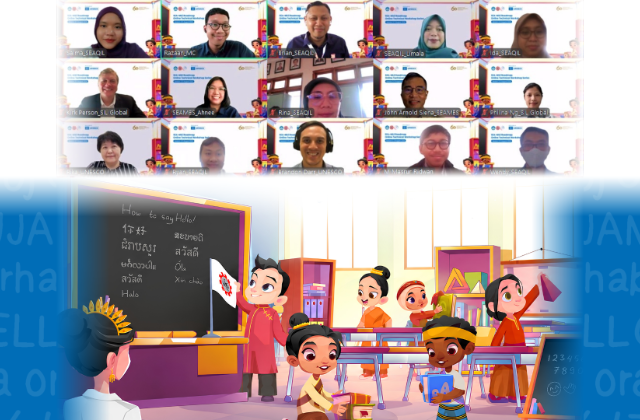
SEA-MLE Roadmap Technical Workshop Series Concludes
Jakarta, 5 August 2026 — SEAMEO QITEP in Language (SEAQIL), in collaboration with the SEAMEO Secretariat and with technical support from UNESCO Regional Office in Bangkok, organised the SEA-MLE Roadmap Online Technical Workshop Series from June to August 2026. The workshop series concluded on 5 August 2026 with the third online session, following two previous sessions held on 10 June and 8 July 2026, with the participation of National Focal Points (NFPs) from SEAMEO Member Countries.
Throughout the workshop series, the NFPs explored the key elements and implementation tracks of the SEA-MLE Roadmap and discussed how these could be applied in their respective national contexts. The sessions also provided opportunities for participants to reflect on the multilingual education (MLE) landscape, priorities, and practices across the region.
The workshop also served as a platform for country-level discussions and information sharing. NFPs shared experiences and information on MLE in their respective countries, including existing practices, priorities, challenges, and areas requiring further attention. These exchanges provided participants with perspectives on the diverse linguistic, cultural, and educational contexts across Southeast Asia and highlighted areas of common interest and shared challenges.
During the final session, participants continued these discussions by presenting their initial considerations for how the SEA-MLE Roadmap could be translated into their respective national contexts. The presentations outlined potential priorities, activities, timelines, expected outputs, performance indicators, and resource requirements. Participants also exchanged perspectives on the approaches being considered and reflected on how the roadmap could be further contextualised within their national education systems. Highlighting the importance of national ownership, Dr Brian Arieska Pranata, Director of SEAQIL, mentioned “Real change begins when countries take ownership of the roadmap and adapt it to their own national contexts. Today, we have seen how countries have tried to translate their priorities into practical action plans.”
Brian added that SEAQIL will continue to support SEAMEO Member countries through bilateral consultations, regional dialogue, stakeholder engagement, and technical assistance as they further explore and implement the SEA-MLE Roadmap in their respective contexts.
Ms Rika Yorozu, Education Programme Specialist at the UNESCO Regional Office in Bangkok, highlighted the importance of continued collaboration and knowledge exchange to ensure that national implementation plans evolve into meaningful action while recognising the diversity of MLE contexts across Southeast Asia.
“Through this workshop, we have made the Southeast Asia MLE Roadmap a real action at the national level across the 11 Southeast Asian countries. The discussions today reminded us that there are many ways to implement multilingual education, and I really appreciate this diversity. We really look forward to working with each one of you and supporting the successful implementation of your national action plans,” said Ms Rika.
She also encouraged continued collaboration across countries, particularly in addressing MLE needs related to migration, displacement caused by climate-related disasters, and conflict.
Mr John Arnold Siena, Deputy Director for Programme and Development at the SEAMEO Secretariat, noted that the workshop provided an opportunity for SEAMEO Member Countries to share their priorities, challenges, and approaches to MLE while recognising the different contexts in which the SEA-MLE Roadmap will be implemented. Reflecting on the contributions from the participating countries, he said, “The submissions and presentations demonstrate that SEAMEO Member Countries recognise multilingual education as an important component of their national education priorities. At the same time, countries are engaging with the roadmap from different starting points, reflecting the diversity of their linguistic landscapes, policy environments, implementation experiences, and resource capacities.”
He emphasised that the outputs from the workshop are not intended to constitute final national implementation plans, but rather to strengthen understanding of the roadmap, support countries in identifying priorities, and initiate dialogue and planning at the national level. He also highlighted the value of regional platforms in enabling countries to learn from one another while adapting approaches to their own linguistic, policy, and educational contexts.
The workshop series highlighted the value of regional exchange in understanding MLE across Southeast Asia. While countries have different linguistic landscapes, policy environments, implementation experiences, and resource capacities, the discussions provided opportunities to identify common challenges, exchange experiences, and explore areas for continued regional cooperation.
SEAQIL and its partners will continue supporting the operationalisation of the SEA-MLE Roadmap through technical assistance, regional dialogue, knowledge sharing, and other capacity-building initiatives. These efforts aim to strengthen country-led approaches and contribute to more inclusive, equitable, and context-responsive MLE across Southeast Asia.
The SEA-MLE Roadmap is available through the SEAQIL website. (Author: Ryan | Editor: Ridwan)
